Makranczy, Gy. (2006): Systematics and phylogenetic relationships of the genera in the Carpelimus group (Coleoptera: Staphylinidae: Oxytelinae). - Annales historico-naturales musei Nationalis Hungarici (Budapest), 98:29-120 >>>"F:\taxa\coleo\scans\Makranczy2006.pdf "
This key is not intended to be a practical identification guide, rather a systematic one, which helps workers determine whether a particular species belongs to a given genus or not. This goal can only be achieved by often relying on anatomical characters (necessitating permanent preparations or dissections). Since the superficial similarity between unrelated taxa can be great, it is unavoidable that less experienced workers examine at least a few of the key features of the genital segments, which can unequivocally determine the placement of a specimen. A more practical approach would require the use of external morphological characters that can vary and result in confusion - not counting the (great) possibility of previously unseen species possessing yet undiscovered character states.
#1
→ 2Abdominal segments III to VI with one pair of laterosclerites per segment. (Deleasterini)
→ 7-Abdominal segments III to VI with two pairs of laterosclerites per segment
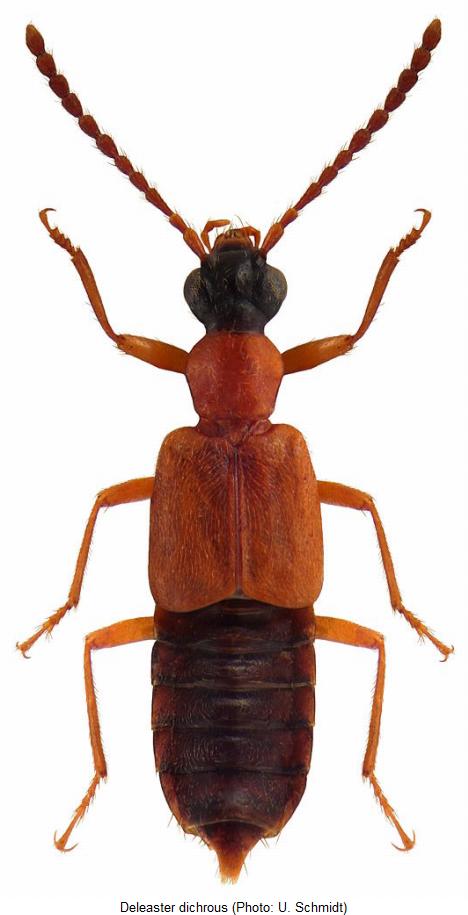
Deleaster Er.Pronotum distinctly convex in cross-section, laterally not margined; elytra without rows of punctures. Tergite VIII with serrate posterior margin. Body surface more or less dull. Habitus [Abb. 1].
Abb. 1
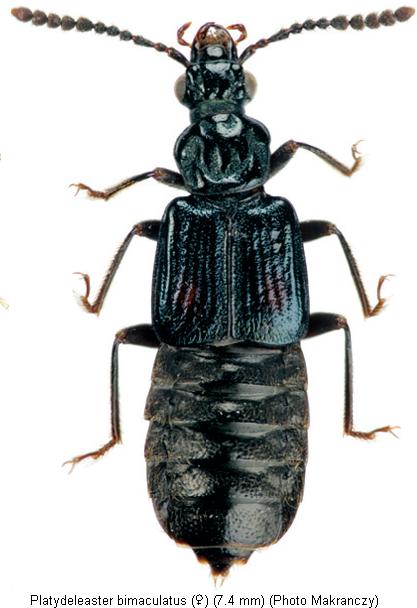
Platydeleaster-Pronotum flat and distinctly margined laterally; elytra with rows of punctures. Tergite VIII with smooth posterior margin. Body surface shining, except for the impressions and rows of punctures on head, pronotum, and elytra [Abb. 2]
→ 8Reduced second sternite with a very short, immobile membranous connection to third sternite (hence only 6 complete sterna can be counted) (Coprophilini)
→ 10-Well developed second sternite articulated to third by a long connecting membrane (hence 7 complete sterna can be counted)
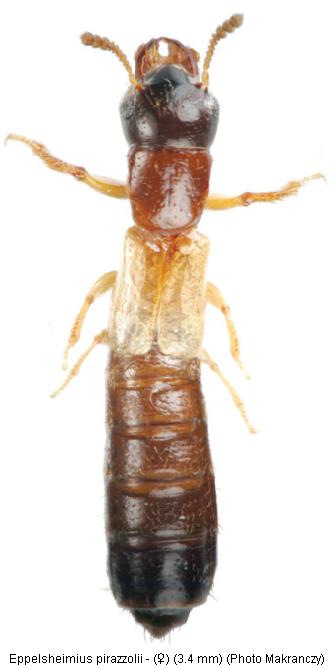
EppelsheimiusSetation behind the front of labrum hyperdeveloped so that the lateral setae reach well beyond four times the length of labrum. Habitus [Abb. 11]
Abb. 11
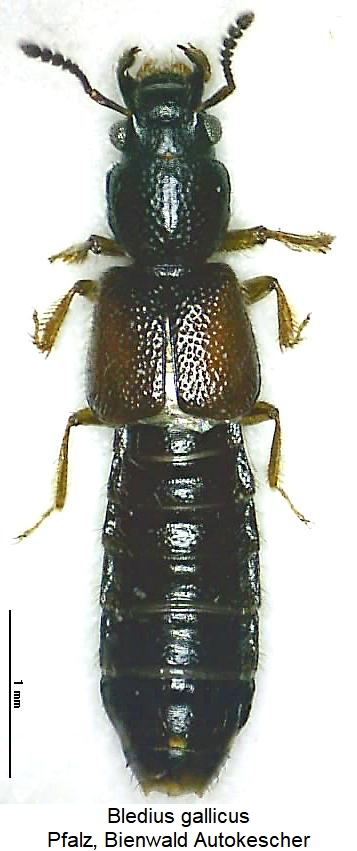
Bledius Leach in Samouelle, 1819-Setation behind the front of labrum is well developed but not reach beyond four times the length of labrum. Habitus [Abb. 12].
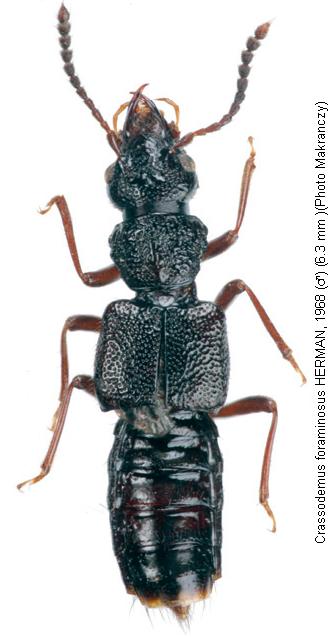
CrassodemusBasal segment of labial palp with strong setation mediad. Distal segment of maxillary palp much longer than penultimate. Habitus [Abb. 21]
Abb. 21
Pareiobledius-Basal segment of labial palp without such setation. Distal segment of maxillar palp quite reduced, much smaller and thinner than penultimate
 Käfer Europas herausgegeben von Arved Lompe sind lizenziert unter den Bedingungen der Creative Commons International 4.0 Lizenz BY-SA (Namensnennung-Weitergabe unter gleichen Bedingungen)