By Arved Lompe (after Z. Kaszab, G.A. Lohse, R. Klinger)
Body elongate, no longer than 3 mm, transversely convex, with prostrate hair. Head sloping, usually rounded. Eyes kidney-shaped. Temples long and rounded or short and sometimes sharply angled. Neck constricted and hidden under the pronotum. Antennae long, filamentous, sometimes long and thin, rarely with a few of the segments serrate. Pronotum broader than the head, usually with a rounded front margin; sides without a border. Elytra broad and elongate-ovate, rarely parallel-sided, the ends of each elytron rounded. Upper surface without rows of punctures or striae. The hollows into which the front coxae are attached are open behind. Hind coxae close together. Hind femora thickened and compressed. Tarsi elongate; first segment of the hind tarsi almost twice as long as the combined length of the other four; fourth segment tiny, partly hidden in the lobes of the third and difficult to see; claws simple, untoothed. The first two abdominal sternites are united, so there are only four apparent segments visible from below. The species live under dry leaves, at the base of old trees on riverbanks, in leaf mould in hollow trees, under loose bark, in dry straw and hay, in damp meadows, on the leaves of bushes and herbs etc. Sometimes attracted to light.
#1
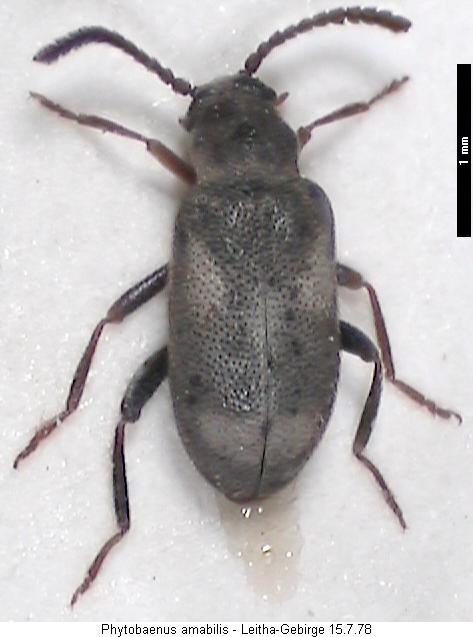
Phytobaenus Sahlberg, 1834Head scarcely visible from above in its normal position, because it is inclined vertically and is covered by the pronotum up to the back of the eyes so that the temples are not visible [Abb. 1]; eyes protuberant and oblique.
Abb. 1
→ 2-Head projecting, visible from above, not covered by the pronotum and showing well-developed temples behind the eyes.
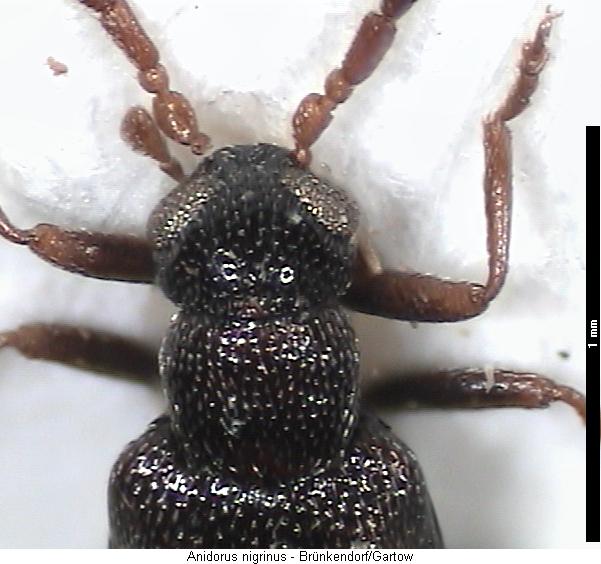
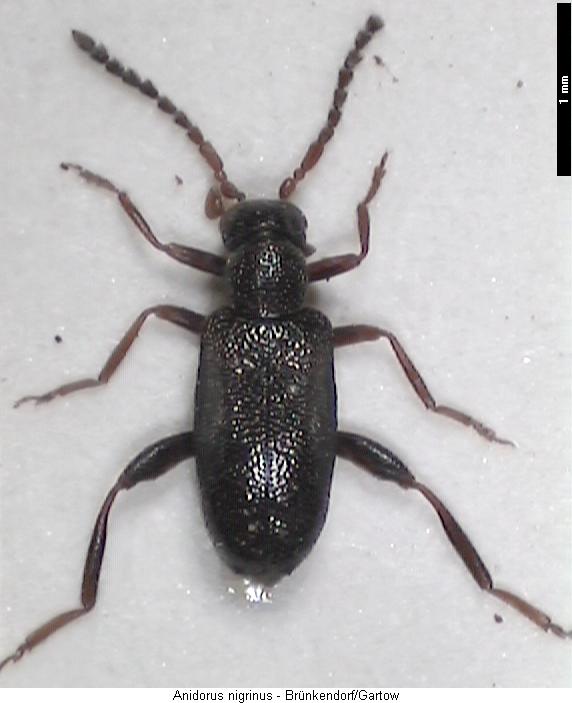
Anidorus Mulsant & Rey, 1866Temples long, almost as long as the transverse diameter of the eye [Abb. 2]. Eyes small, strongly incised on the inner side. The third segment of the antennae in males is noticeably enlarged and in females it is clearly longer than the fourth segment. Slender species with the elytra strongly compressed at the sides behind the shoulders [Abb. 3]. Colour of the elytra usually black to blackish-brown. Pronotum often pale reddish-brown.
Abb. 2Abb. 3
-Temples shorter than the transverse diameter of the eye. Third segment of the antennae shorter or only slightly longer than the fourth. General colour of the elytra usually ochreous, rarely darkened or bi-coloured. ...3
#3
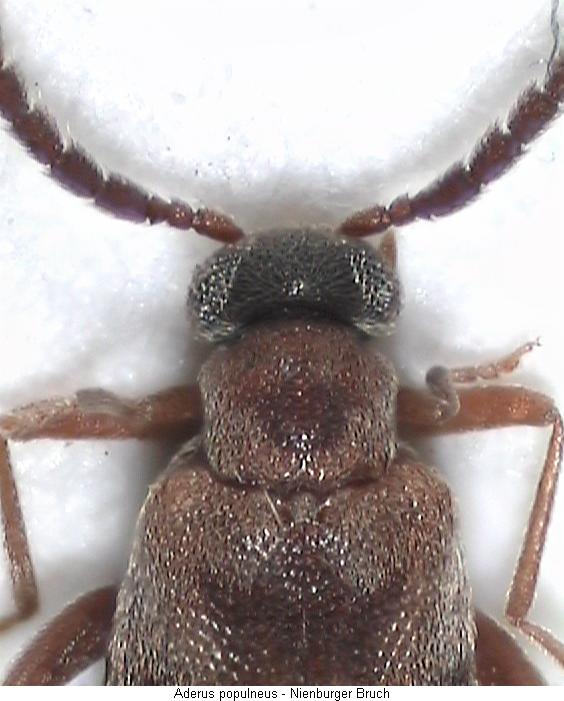
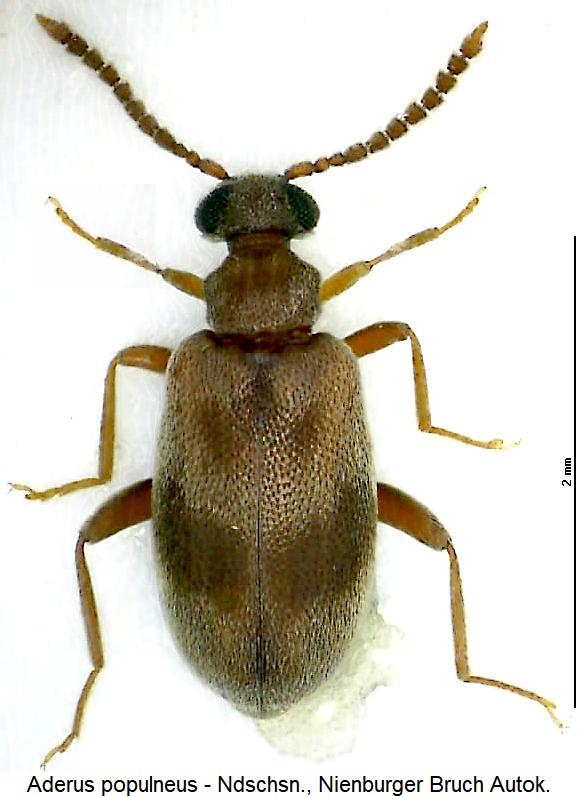
Aderus Stephens, 1829.Third segment of the antennae in females half the length of the fourth and in males even shorter, a little narrower and shorter than the second segment [Abb. 4]. Habitus [Abb. 5].
Abb. 4Abb. 5
→ 4-Third segment of the antennae at least as long as the fourth segment.
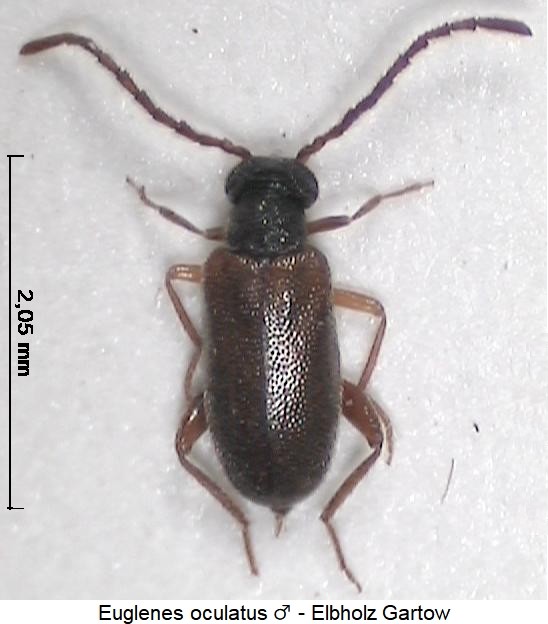
Euglenes Westwood, 1830Antennae long, segment three longer than segment two; segments 4-6 clearly longer than broad; last segment of the antennae distinctly elongate [Abb. 6]. Elongate species with well-developed sexual dimorphism. Eyes very large in males, almost touching on the frons; antennae more or less serrate.
Abb. 6
→ 5-Antennae shorter, segment three not or only slightly longer than segment 2; segments 4-6 never longer than wide, usually broader than long.
Otolelus Mroczkowski in Burakowski & al., 1987Elytra coarsely punctured particularly towards the sides. Pronotum simply convex without impressions. Colour of the elytra very variable, yellowish-red, usually darker along the suture and towards the sides or rarely completely dark [Abb. 7].
Bild fehlt: otolelus_pruinosus_hab.jpgAbb. 7
→ 6-Punctures on the elytra fine and dense to very dense. Pronotum with a deep impression each side in the rear half or with a complete transverse impression. Body uniformly brown with the head and pronotum indistinctly darker.
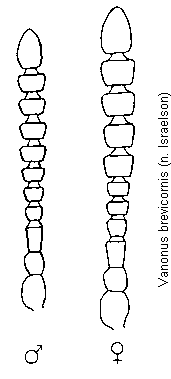
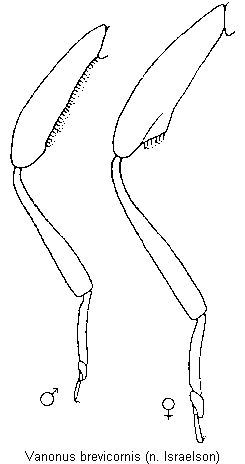
Vanonus Casey, 1895Head, viewed at higher magnification (x50) with clear, isolated punctures. Distance between the antennae at the base distinctly less than their distance from the eye. Penultimate segment of the antennae broader than long, symmetrical [Abb. 8]. Inner side of the hind femora with a specialised comb of hair [Abb. 9].
Abb. 8Abb. 9
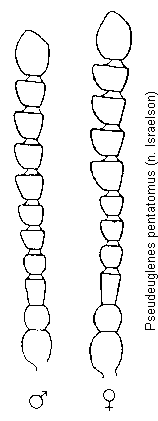
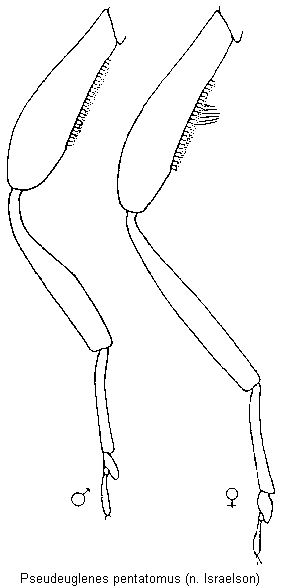
Pseudeuglenes Pic, 1897-Viewed at x50 magnification without discernible punctures, completely dull in males and rather shining in females. Antennae attached closer to the eyes than they are to one another. Antennae longer with segments 7-10 weakly asymmetrical and scarcely broader than long [Abb. 10]. Inner margin of the hind femora with specialised hairs in both sexes [Abb. 11].
 Käfer Europas herausgegeben von Arved Lompe sind lizenziert unter den Bedingungen der Creative Commons International 4.0 Lizenz BY-SA (Namensnennung-Weitergabe unter gleichen Bedingungen)